
AI Content Writing Style Guidelines: How to Write One
Learn how to write AI content style guidelines that cover voice, sourcing, fact-checking, images and formatting, with a template and a QA scorecard you can run on every post.

Contents
CNET published AI-assisted finance explainers under the “CNET Money Staff” byline, and disclosure of AI involvement was not prominent. Futurism flagged errors, including an APR/APY mix-up and wrong compound-interest math, across 77 AI-assisted articles (Futurism). WIRED reported that 41 of the 77 stories needed correction. Those posts had a voice.
They read fine. What they didn't have was a sourcing rule that anyone enforced.
Most AI style guides spend nearly all their space on tone. Popular templates, Atomwriter's included, are built around voice and style (Atomwriter). That helps, but it won't catch a fake citation.
We treat a style guide as a spec. A finished article either passes it or fails it, on voice, sourcing, verification, images and formatting. Below you'll get both pieces: a template you can copy and a QA scorecard to run on every post.
Prerequisites: What You Need Before You Start
Collect three things before you write a single rule.
- 3 to 5 published posts you'd sign without edits. These are your voice samples. Forte Labs' walkthrough has ChatGPT pull voice, tone, mood, sentence structure and rhythm out of sample writing (Forte Labs). Pick posts you're proud of. Skip the ones you'd merely tolerate.
- Your brand basics in one file. Semrush lists the core parts of a style guide as company background, voice and tone, writing style, grammar and brand terminology (Semrush). Add your brand colors as hex codes, because image rules need them later.
- One owner and one publish target. Name the person who updates the guide. Name the CMS where posts land, such as WordPress, Ghost or GitHub. The Marketing Speak recap frames AI writing guidelines around human review and accountability (Marketing Speak). If nobody owns the guide, it goes stale within a quarter.
1. Define the Audience and Purpose
"Marketers" is not an audience. A model can't calibrate depth from that one word.
Write the reader as a person with a role, a skill level and a reason to read:
- Weak: "Marketers."
- Strong: "Solo SaaS founders publishing 1 to 4 posts a week who know what frontmatter is."
The strong version tells the writer what to skip and what to explain. Every's AI style guide shows how one publication tunes structure to the specific people who read it (Every).
Next, state what every post must do for that reader. Keep it to three or four rules:
- Answer one search question fully.
- Include one original example.
- End with one concrete action.
That lines up with how Google talks about AI search. A secondary summary of Google's guidance says AI Overviews and AI Mode are rooted in core Search ranking systems, and it tells publishers to skip AEO/GEO shortcut hacks and focus on clear structure and unique content (Eyesift).
Finally, turn technical depth into a rule the model can follow. "Define acronyms once. Never explain what a CMS is." That's testable. "Write for an intermediate audience" isn't.
2. Set Voice, Tone, and Sentence Rules
Keep voice and style apart. Voice is who you sound like. Style is the mechanical layer: punctuation, length and formatting. Atomwriter makes the same split in its "Voice Guide vs. Style Guide: Why You Need Both" section (Atomwriter).
Then rewrite every voice rule so a reviewer can mark it pass or fail:
| Vague rule | Testable rule |
|---|---|
| Be conversational | Use contractions. Address the reader as "you." |
| Be concise | Paragraphs of 1 to 4 sentences. |
| Be confident | No hedge words. Cut every term on your hedge list. |
Every's guide has a "Sentence-level preferences" section written at this grain (Every). That's the level you're aiming for. If two editors could disagree about whether a rule passed, rewrite it.
Add 4 to 6 verbatim style anchors from your own copy. Adjectives drift. Real sentences give the model a rhythm to match. Here are two of ours:
- "Real citations. No fabricated URLs."
- "You see every step. No black box."
This is the same move as Forte Labs' sample-writing step (Forte Labs), compressed into lines the writer sees on every run.
Add one tradeoff rule: "When a claim needs qualifying, qualify it in the same sentence." As an illustration, "4 minutes per post" beats "lightning-fast." The first is a number someone can check. The second is a mood.
3. Specify Formatting and Structure Rules
Structure rules are the easiest to enforce, so write them precisely:
- One H1 per post.
- Scannable H2s, with no section longer than about 300 words.
- Paragraphs of 1 to 4 sentences.
- Bulleted lists only for 3 or more parallel items.
- A required FAQ section and a required Sources section.
Tinkering With Ideas covers editorial rules at this level, including headings, punctuation and links (Tinkering With Ideas). In Ryterr, every post comes with plain headings, an FAQ section and a Sources section linking to the pages that back each claim (Ryterr).
Write image rules as a spec, not a mood. "On-brand visuals" means nothing to an image model. This does:
- Hex codes for primary, accent and background.
- One style hint reused on every image in the post.
- Aspect ratios: 16:9 hero, 4:3 inline.
- A fixed count per post.
- Alt text on every image.
Atomwriter treats accessibility and inclusive language as a core section of the guide (Atomwriter). Alt text belongs there.
Last, name the deliverables: title, slug, meta description, and Markdown and HTML files. A post missing its slug isn't publish-ready, however good the prose is. Ryterr fills in title, slug and description and exports Markdown and clean HTML (Pricing).
4. Set Sourcing and Fact-Checking Standards
This is the section most guides skip. It's also where the damage happens.
A study of GPT-4o citations in mental health found 56% contained errors, with one in five hallucinated, across a sample of 176 (Taylor & Francis). A study of 13 large language models found citation hallucination rates ranging from 14.23% to 94.93% (AuthorityTech). Those rates vary a lot by benchmark, so don't treat any single headline rate as yours. Write rules that hold no matter which model you use.
Rule 1: every statistic, price, name and date links to the page it came from. Prefer primary sources. Never cite an AI answer. In the Tow Center study, AI search engines gave incorrect answers to more than 60% of 1,600 news citation queries (Tom Riley).
Rule 2: the writer works from supplied source documents, not memory. Grounding changes the numbers. On the Vectara leaderboard of 11 May 2026, the best model hallucinated 1.8% of the time on grounded summaries, versus 24.2% for the worst (Tom Riley).
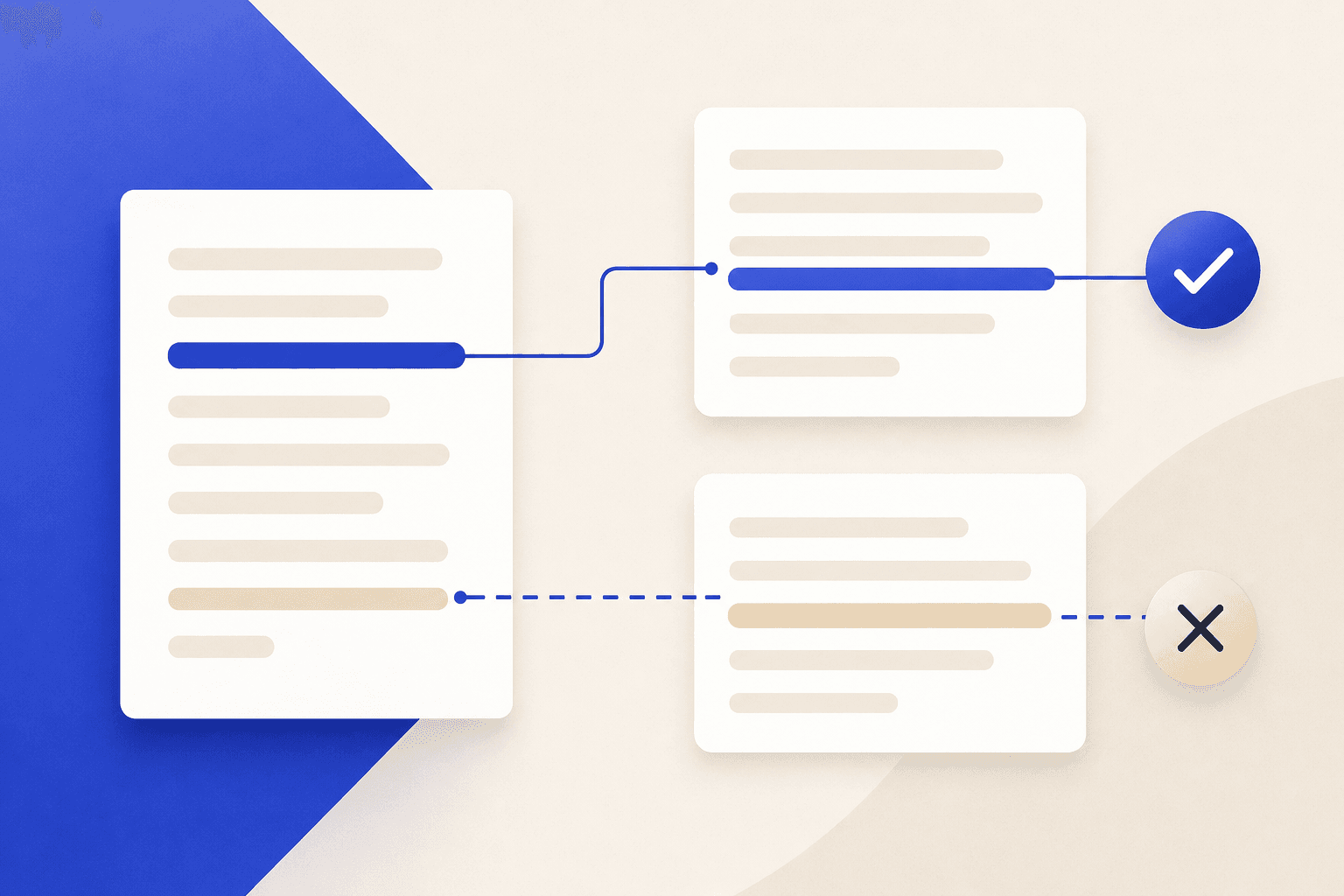
Rule 3: verification is a separate step from writing. The checker confirms three things: the URL resolves, the quote appears on the page, and the number matches. Human review alone doesn't cover this. GPTZero scanned 4,841 accepted NeurIPS 2025 papers and found 100 confirmed hallucinated citations across 53 papers, even though each paper had 3 to 5 expert reviewers (ScienceDirect). Of those, 66% were total fabrications, 27% were real papers with corrupted details such as wrong authors or venues, and 4% hijacked a real identifier (Suprmind). That 27% is why "the paper exists" doesn't count as a pass.
Rule 4: set a minimum sourcing density. In a sample of 531 ranking pages across 40 B2B content-marketing queries, Avoid Content measured a median of 0.9 statistics per 1,000 words, with 27% of the pages naming zero sources and 13% carrying a dead link (Avoid Content). Set a floor, such as "at least 3 sourced numbers per 1,000 words, zero dead links."
We built Trace for this step: it checks each statistic, price, name and date against its source and lists every claim next to that source (Ryterr).
5. Add Banned Words and Claim Limits
Some phrases mark copy as machine-written on sight. Keep a banned list in the guide: hype words, hedge words, stock openers like "in today's fast-paced world," and em dashes. Then scan for them automatically, because reviewers miss them after the third post. Semrush's style guide advice covers terminology and grammar but doesn't address AI-detectable phrasing (Semrush), so you'll have to write this part yourself.
Then set claim limits:
- No superlatives without a source.
- No invented customers, quotes or bylines.
- If the research doesn't support a claim, cut it.
Sports Illustrated shows the cost. Product reviews ran under fake author bylines with AI-generated headshots, and The Arena Group removed the content and ended its AdVon partnership (PBS NewsHour). Tom Rosenstiel, a University of Maryland professor who teaches journalism ethics, put it plainly: "A secret is a form of lying." (PBS NewsHour).
Quotes need their own rule. A court database had listed 946 legal cases involving AI-hallucinated content by February 16, 2026. Of those, 647 involved hallucinated citations and 107 involved false quotes (Taylor & Francis). Your rule: quotes must appear verbatim on the linked page.
Here's the template. Copy it and swap in your details.
AUDIENCE
- Solo SaaS founders publishing 1 to 4 posts a week.
- They know what frontmatter is. Never explain what a CMS is.

PURPOSE
- Answer one search question fully.
- Include one original example. End with one action.

VOICE
- Anchors: "Real citations. No fabricated URLs." / "You see every step. No black box."
- Use contractions. Address the reader as you.

SENTENCE RULES
- Paragraphs of 1 to 4 sentences.
- Qualify a claim in the same sentence as the claim.

STRUCTURE
- One H1. Scannable H2s. Lists only for 3+ parallel items.
- Required: FAQ and Sources sections.

IMAGES
- Primary #10B981, accent #06B6D4, background #F5F5F5.
- One style hint on every image. Hero 16:9, inline 4:3, 3 per post.
- Alt text on every image.

SOURCING
- Primary sources only. Link every number, price, name and date.
- Write from supplied source documents, not memory.
- At least 3 sourced numbers per 1,000 words.

VERIFICATION
- Separate step from writing.
- URL resolves. Quote appears verbatim. Number matches.

BANNED WORDS
- Everything in banned-words.txt. Zero em dashes.

CLAIM LIMITS
- No superlatives without a source.
- No invented customers, quotes or bylines. Unsupported claim: cut it.

DELIVERABLES
- Title, slug, meta description.
- Markdown and HTML files.
Verify the Outcome
Score the finished article, not the draft. The test is simple: could it publish with zero rewrites?
| Check | How to test | Pass condition | Blocks publish |
|---|---|---|---|
| Every number has a linked source | Count numbers vs source links | Equal | Y |
| All source URLs resolve | Open or ping each link | No errors | Y |
| Quotes appear on the linked page | Search the page for the quote | Verbatim match | Y |
| Sourcing density meets the floor | Sourced numbers per 1,000 words | At or above floor | N |
| Banned words and em dashes | Text search | 0 hits | N |
| One H1, FAQ and Sources present | Scan headings | All present | N |
| Images match spec, alt text present | Compare to hex codes and style hint | All match | N |
| Title, slug, meta filled | Check fields | All filled | N |
The rule: any sourcing failure blocks publishing. Style failures go back for one correction pass.
The stakes are real, with a caveat. Digital Applied's analysis of Google's March 2026 core update reports that sites publishing hundreds or thousands of AI-generated pages without editorial oversight saw 50-80% traffic drops (Digital Applied). That's a vendor analysis, not a Google statement. Passing a scorecard also doesn't guarantee rankings. It guarantees you aren't shipping fabrications.
A scorecard can invite box-ticking, too. A post can link a real source and still carry the wrong number. Spot-audit a few passed posts by hand each month.
In Ryterr, a post with an open fact-check finding waits for review, and a scheduled run won't publish it. On the sample post, all 25 claims were verified with zero open review warnings (How it works).
Troubleshooting
Voice drifts generic. Cause: your voice rules are adjectives. Fix: add verbatim anchors and 2 sample passages, following Forte Labs' sample-writing method (Forte Labs).
A citation points to a real paper with wrong details. Cause: the checker only confirmed the paper exists. Fix: match author, title and the quoted line. In the NeurIPS audit, 27% of the bad citations were real papers with corrupted details (Suprmind).
A source misstates the news. Cause: an AI assistant was cited instead of the publisher. Fix: link the original article. The EBU/BBC study found 45% of over 3,000 AI news answers misrepresented the content, across 18 countries and 14 languages (Tom Riley).
Links die after publishing. Cause: links were only checked once. Fix: recheck on a schedule and treat a dead link as a blocking failure. Avoid Content found a dead link on 13% of the 531 ranking pages in its sample (Avoid Content).
FAQ
What's the difference between an AI style guide and a prompt?
A prompt is one instruction for one run. A style guide is the standing spec that every prompt, draft and review checks against. Prompts change per topic, but the guide stays fixed so you can compare posts over time.
How many sources per post should the guide require?
Set a density floor, not a fixed count. "At least 3 sourced numbers per 1,000 words" scales with post length. For reference, Avoid Content measured a median of 0.9 statistics per 1,000 words across a sample of 531 ranking pages for 40 B2B content-marketing queries, so a floor of 3 puts you above the measured median.
Can an AI check its own citations?
Not reliably. The same model tends to repeat its own blind spots. Run verification as a separate step that opens the actual page and checks that the URL resolves, the quote appears and the number matches.
Should image rules live in the same style guide?
Yes. Images ship with the post, so they should pass the same review. Keep hex codes, style hint, aspect ratios, count and alt text rules in one section so the writer and the image step read from the same file.
How often should the guide be updated?
Update it whenever a failure pattern repeats. Log scorecard failures for each post. If the same check fails three times, the rule behind it needs rewriting, and the owner you named at the start makes that change.
Sources
- Futurism: CNET AI errors
- Atomwriter: AI writing style guide template
- Forte Labs: How to create an AI style guide
- Semrush: Content style guide
- Marketing Speak: Using AI for content writing authentically
- Every: AI style guide
- Eyesift: Google AI content guidelines
- Tinkering With Ideas: Style guide for AI
- Taylor & Francis: Accountability in Research
- AuthorityTech: AI citation accuracy and hallucination verification
- Tom Riley: AI hallucination statistics
- ScienceDirect: NeurIPS hallucinated citations perspective
- Suprmind: AI hallucination rates and benchmarks
- Avoid Content: Fact-checking AI content
- PBS NewsHour: Sports Illustrated AI-generated stories
- Digital Applied: Google March update and scaled content abuse
Your next step
Copy the template, run your next 3 AI posts through the scorecard, and log which checks fail. The failures show you which rules need tightening. To see a claim-by-claim fact-check report on a real post, try 2 free Ryterr posts with no card needed. The Free plan runs the same research and fact check as paid posts.
Ryterr Team
Written with Ryterr: researched on the live web, written in our voice and fact-checked before publishing.