


Ditch Ghostwriters: Publish SEO Blogs in Your Brand Voice
Hiring a ghostwriter sounds simple until you're three revision rounds deep on a post that still doesn't sound like you. The money is only part of it. The briefing doc, the back-and-forth, the final pass where you rewrite the sentences that were too polished or too bland, that's where the time goes. And when you're a solo founder publishing regularly, time is the constraint the retainer doesn't solve.
This isn't a tool review. It's a workflow walkthrough. Here's what the switch looks like in practice.
What a Ghostwriter Actually Costs You
The obvious cost is the retainer. Good ghostwriters who can match your voice, research a topic properly, and ship a post with citations cost real money. Budget-level writers produce budget-level output. You end up editing heavily either way.
The hidden cost is the process around the writing. Before a ghostwriter can draft anything useful, you have to produce a brief. That means pulling competitor posts, identifying the angle, naming the sources you want cited, and writing out the tone guidance in enough detail that a stranger can approximate your voice. That work takes hours. Per post.
Then comes the revision cycle. First draft comes back and the keyword placement is off, or the intro reads like a press release, or the citations link to paywalled content. You send notes. You wait. The post ships on day twelve instead of day two.
The voice problem is the most persistent one. Even skilled ghostwriters produce serviceable prose, not your prose. Every post needs a round of edits before it sounds like something you'd actually publish under your name. That's not a failure of the writer. It's a structural limitation of the briefing model. They weren't there for the twenty blog posts you wrote before hiring them.
The Workflow Ryterr Runs (Step by Step)
The pipeline runs in six steps, and you can watch each one happen.
Step 1: You enter a topic. Live web research starts immediately, pulling competitor articles, SERP data, and supporting sources before a single word is drafted. This isn't a keyword lookup. It's a read of what's already ranking and why.
Step 2: Competitor gap analysis runs on those results. The model identifies what the top-ranking posts miss, thin citation support, skipped subtopics, missing examples, and targets those gaps directly. Your post is built around what the current results don't cover well.
Step 3: The writer model drafts against your brand voice anchor. Not a generic "professional but conversational" preset. The specific phrases and rhythm you defined at onboarding.
Step 4: A fact-check pass runs citations against live URLs. Fabricated sources get flagged before you see the draft. If a claim can't be sourced, it either gets cut or you see the flag and make the call.
Step 5: A five-dimension quality audit scores the post. You see the score before you decide to publish.
Step 6: Markdown export with SEO frontmatter. Copy, paste, publish.
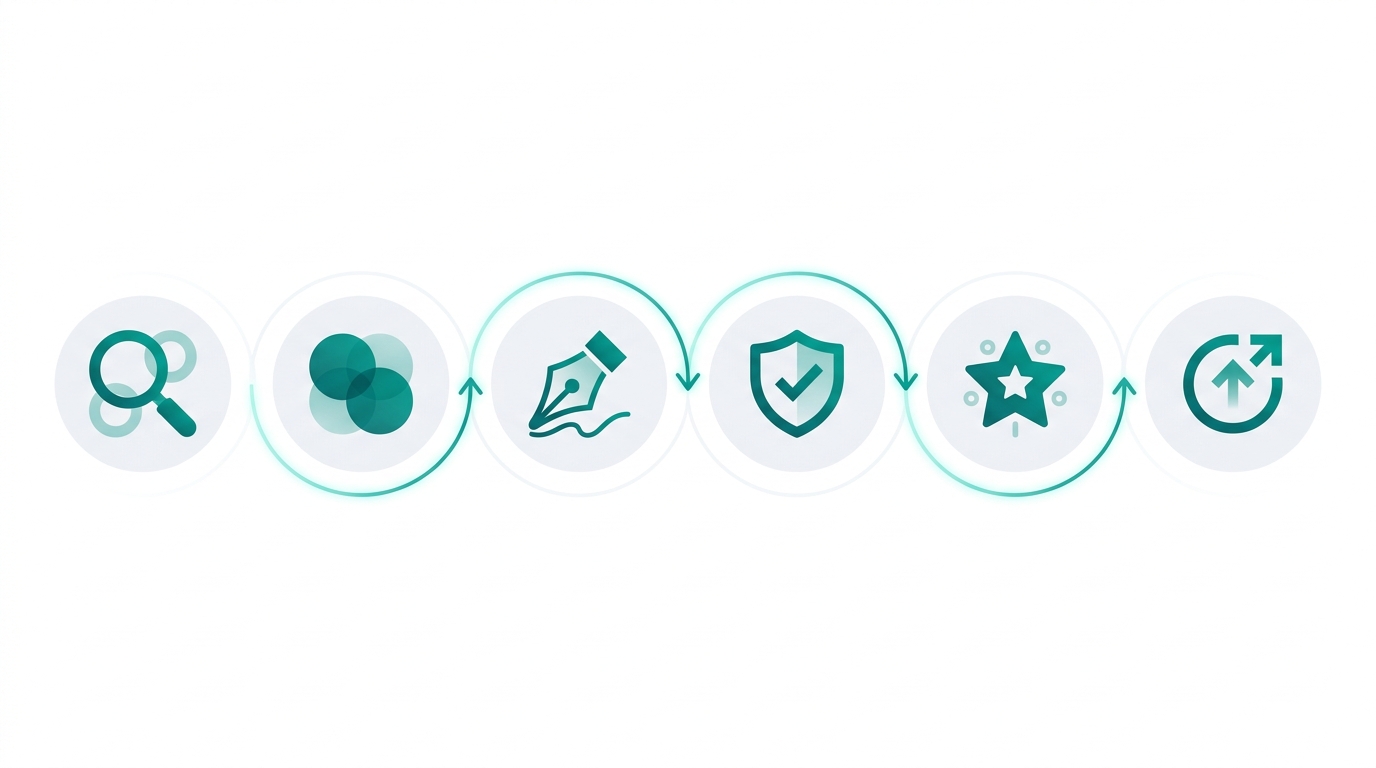
Total elapsed time from topic input to a reviewable draft: around five minutes. Not five days.
Before and After: Solo Founder Workflow Comparison
The old workflow looks like this. You have a topic idea. You spend a couple of hours writing a brief document that explains the angle, the audience, the sources you want cited, and the tone. You send it to the ghostwriter. Five to seven days later, a draft arrives. You send revision notes. Another round or two follows. You do a manual SEO pass. You publish. Elapsed time: one to two weeks, sometimes longer.
The new workflow: topic input, pipeline runs, you review the draft, you publish. Same day.
The quality difference shows up in two specific places.
First, citations. Ghostwriter posts often ship without inline citations, or with citations that link to content the writer didn't actually read. Ryterr posts include sourced claims with live URLs by default, because the fact-check pass runs before the draft reaches you.
Second, voice. The brand voice anchor means the model matches your sentence rhythm. Not a house style, not a generic AI register. The specific phrases you actually use, the editorial rules you actually follow. "Blog posts that actually rank" not "comprehensive content strategies." That difference is the anchor working.
What "Brand Voice" Actually Means in Practice
Most people fill in a brand voice field with something like "professional but approachable" or "friendly and informative." That input produces exactly the kind of output you'd expect from it: generic, serviceable, not quite yours.
Specific anchors work. Concrete ones.
Pull lines directly from your live marketing copy. Not paraphrases of what you were trying to say. The actual sentences. "Real citations. No fabricated URLs." "You see every step. No black box." "Copy, paste, ship." When the model has those to pattern-match against, it produces output with the same rhythm.
Add editorial rules, stated plainly:
- When choosing between a clever phrase and a direct one, pick direct.
- When a claim needs qualifying, qualify it in the same sentence, not a footnote.
- Name tradeoffs instead of selling around them: "4-6 minutes per post" rather than "lightning-fast."
- First-person plural for the company. Second-person for the reader.
The brand voice field is the highest-leverage input in the whole system. More than keyword targeting. More than topic selection. A weak voice anchor produces posts you'll spend an hour editing. A specific one produces posts you publish with light review.

The Five Dimensions Ryterr Scores Every Post On
The quality audit runs automatically. You see the score before you publish. Five dimensions:
- Structure. Clear hierarchy, short paragraphs, logical section flow. Walls of text fail this one.
- Citation density. Non-obvious claims sourced with live, verifiable URLs. Unsourced assertions get flagged.
- Keyword placement. Target keyword in the H1, in the first 100 words, and in at least two H2s.
- Readability. Sentence length variation, Flesch score in range for the target audience.
- Brand voice match. Does the draft use the phrases, rhythm, and editorial rules from the onboarding anchor?
You see this before the post ships. That's the point. The audit is a pre-flight check, not a post-mortem on a post that underperformed for six months before you noticed.
What Competing Tools Miss (and Why It Matters for Solo Creators)
Tools like Jasper, Writesonic, and Surfer each solve one piece of the problem. Jasper drafts. Surfer scores keyword density. Neither fact-checks, and neither runs a full quality audit on the output before it reaches you. The Averi.ai comparison of AI content tools highlights exactly this fragmentation: different tools, different dashboards, different outputs that still need assembly.
Agencies can live with that. They have editors who stitch the pieces together. A solo founder can't staff that gap. You either get the whole pipeline or you're back to prompt-engineering drafts by hand, running them through a separate SEO checker, manually verifying citations, and doing the voice cleanup yourself.
The trust problem is specific to creators who publish under their own name. A fabricated citation in a post is your liability. The tool that generated it has no byline. You do. That's why the live fact-check pass isn't optional and isn't buried in settings. It runs every time.

FAQ
Does the brand voice anchor actually hold across different post topics?
It depends on how specific your anchor is. Vague inputs like "conversational and data-driven" drift quickly when the model generates content on unfamiliar topics. Concrete anchors, with quoted lines from your real copy and explicit editorial rules, hold much better because the model has specific patterns to match, not just a mood to approximate. If a post sounds off, the fix is almost always in the anchor, not the topic.
What if my brand voice hasn't been fully defined yet?
Start with what you have. Pull three to five sentences from your existing writing that sound the most like you. Write down one or two editorial rules you actually follow. That's enough to get a usable first draft. You'll learn more about your voice from reviewing that draft than from trying to define it in the abstract first.
How much review does the draft actually need before publishing?
It depends on how well-tuned your brand voice anchor is. With a specific anchor and a clear topic, most drafts need light review: checking that the framing matches what you intended, that no citations got flagged, and that the quality score is where you want it. Expect more editing early on while you're calibrating the anchor, less over time as it gets specific.
What happens if a cited source goes offline after the post is published?
The fact-check pass verifies URLs at the time the draft is generated. If a source goes offline later, that's a broken link you'd catch during regular content maintenance, same as any other post. The live check at generation time catches fabricated URLs and sources that are already inaccessible, which is the most common failure mode with AI-generated content.
Is this actually faster than hiring a writer once the briefing overhead is accounted for?
Yes, materially so, because the briefing step is built into the pipeline rather than handed off to a human who needs it explained. The research step, competitor gap analysis, and brand voice anchor together replace most of what a brief document communicates to a ghostwriter. You enter a topic. The system does the context-gathering work that used to happen in a two-hour brief doc.
Sources
Go to ryterr.com, connect your domain, and paste your brand voice anchor into /settings/brand. Then run one post through the full pipeline. The draft takes about five minutes. If it doesn't sound like you, the brand voice field needs more specific input. Fix that first, then ship. The first post you publish with the "Written with Ryterr" badge is the proof. Not a claim. Proof.