

Maintaining Brand Voice Across 50+ AI-Assisted Posts
A system for keeping your brand voice consistent across dozens of AI-written posts without an editorial team. Four concrete steps to prevent voice drift.
Contents
83% of marketers say AI makes them faster. Only 25.6% say the output actually outperforms what they'd written manually (averi.ai). That gap is not a technology problem. It's an input problem.
Most founders get fast results from AI early on. Post 3 sounds decent. Post 7 sounds close. By post 15, something feels off but you can't name it. By post 30, the blog reads like it was written by five different people who all attended the same generic SaaS conference.
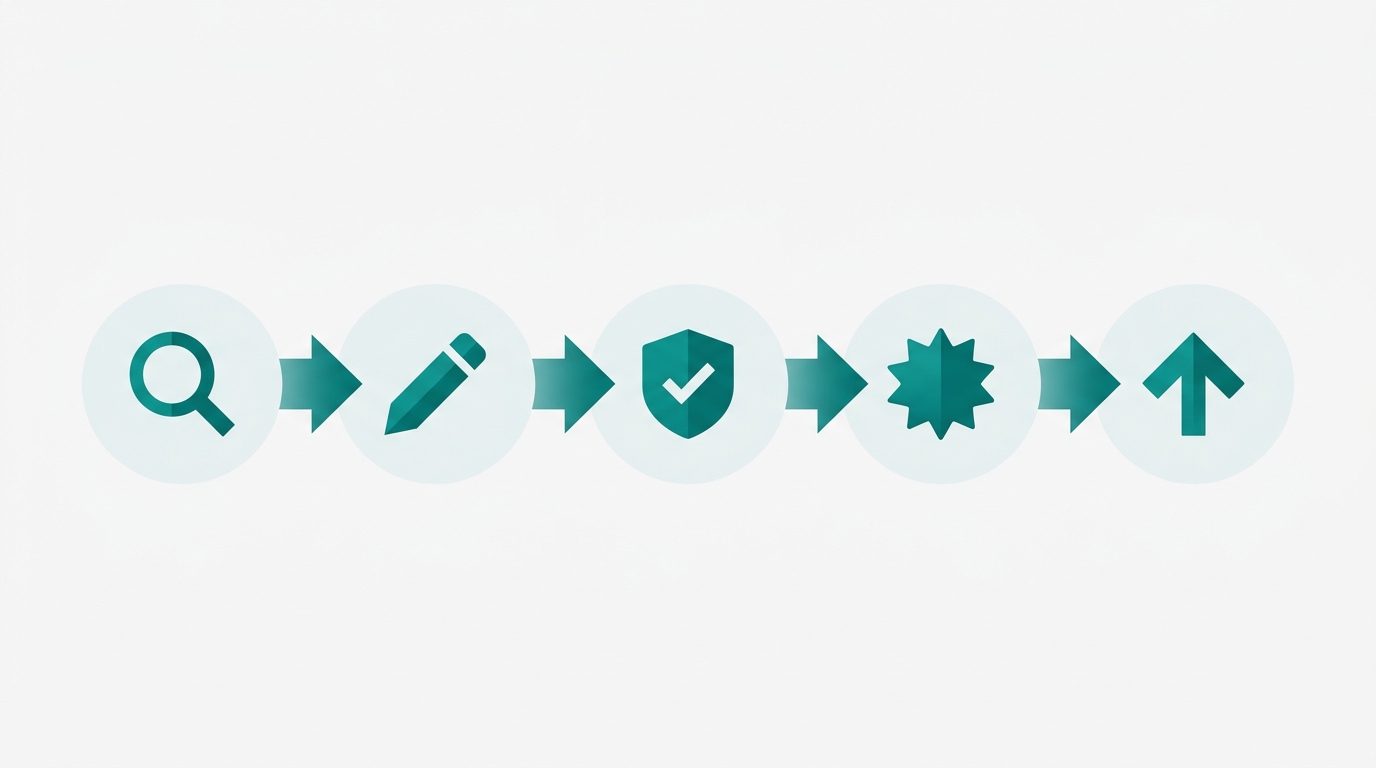
This is not a pep talk about "staying authentic." This is a system. Four steps, each one concrete, each one designed to hold up across 50+ posts without an editorial team standing behind you.
Why Voice Drifts (and Why It Matters More Than You Think)
AI writing tools amplify what you give them. If your brand voice input is vague, the output will be consistently, scalably vague. "We're direct and conversational" is not a brand voice. It's an aspiration that an AI model will interpret differently every single time it drafts a post.
The failure mode is quiet. Early posts feel fine. But without a documented voice system, the model is pattern-matching to your topic, not your style. It defaults to the median of whatever it's seen in its training data: hedge words, passive constructions, generic transitions. Each post drifts a little further from how you actually write.
This matters operationally, not just aesthetically. Organizations with documented content strategies are more likely to report success, according to the Content Marketing Institute (averi.ai). That stat is about strategy documentation broadly, but it applies directly to voice: writing the rules down is not overhead. It is the work.
Solo founders feel this acutely. There's no managing editor to catch drift. No style guide enforcer. No second pair of eyes that knows how you've always written. The system prompt is your editorial team.

Step 1: Encode Your Voice Into a Reusable System Prompt
A system prompt is not a one-time setup. It's a persistent instruction block the model reads before every post it writes. The difference between a system prompt and a per-post prompt matters: per-post prompts tell the model what to write about; the system prompt tells it how you write, at all times, regardless of topic.
Every brand voice system prompt needs five components:
- A banned words list (specific words and phrases, not categories)
- Style anchors: verbatim phrases pulled from your real published copy
- Sentence rhythm rules (short sentences first, mix lengths, no passive constructions)
- A tradeoff naming convention ("4-6 minutes per post" rather than "lightning-fast")
- First/second person rules (who is "we," who is "you")
The style anchors are the most important part and the most skipped. "Direct and conversational" tells the model almost nothing. "Blog posts that actually rank" is a sentence with a rhythm, a word choice, and an implied attitude. The model can match that. It cannot match an adjective.
Treat the system prompt like code. Keep it in version control. When your voice shifts, update the prompt first. Then run the next post through it. That sequence matters because it separates intention from execution. If you update the prompt after noticing drift, you're reacting. If you update it before every new phase of publishing, you're governing.
Step 2: Build Research and Competitor Analysis Into Every Run
AI without live web research fabricates. That's not a bug that gets patched. It's how language models work: they predict text, and when there's no grounding source, they predict plausible-sounding numbers and URLs that don't exist.
The fix is structural. Wire a research step into the pipeline before any draft is written. What that step should produce:
- 5-8 sourced statistics with URLs
- 2-3 competitor article summaries with identified gaps
- A list of claims that need citation before drafting starts
Competitor gap analysis does double duty here. It tells you what to write about and how to differentiate the angle. If every competing article on a topic is theoretical, your post goes operational. If every competitor avoids numbers, yours leads with them. That's not just SEO strategy. That's voice.
The research artifact also becomes your fact-checking source. Every stat in the draft should trace back to a URL captured in the research step. Not added post-hoc after the draft is written. If the stat isn't in the research artifact, it doesn't go in the draft.
Step 3: Enforce Inline Citations and Fact-Checking Before the Draft Ships
One fabricated URL in post 3 is embarrassing. One per post across 50 posts is a trust-destroying pattern that compounds silently until someone calls it out publicly.
Inline citation enforcement is not proofreading. It's a structured pass that checks four things:
- The URL resolves
- The stat matches what the source actually says
- Any quote is verbatim or clearly marked as paraphrase
- No invented company names or product features appear as fact
This step changes where your attention goes. MIT research cited by Averi.ai found that professionals using AI assistance spend more time on creative and strategic thinking compared to those working without AI (averi.ai). That shift only happens if the mechanical work is genuinely handled. When you know every claim has been checked, your review time goes to judgment calls: does this post actually say something, does the angle hold, does the conclusion earn its place. That's the work worth doing.
Step 4: Apply a Five-Dimension Quality Score to Every Post
At post 50, you cannot remember what post 12 felt like. A gut check is not repeatable. A score is.
Five dimensions, each one with a specific question it answers:
- Voice: Does the draft use any banned words? Does it match sentence rhythm? Does it use first/second person correctly?
- Accuracy: Are all claims cited? Do citations resolve? Are numbers correctly attributed to their source?
- Structure: Does the post open with a concrete observation? Are H2s spaced correctly? Are paragraphs short?
- SEO: Does the target keyword appear in the H1, first 100 words, at least two H2s, and the meta description?
- Originality: Does the post cover a gap the competing articles miss? Does it include a data point or example not found in the top 5 SERP results?
Set a minimum threshold before a post is eligible to publish. Something like 80/100 works. When a post scores below it, use the dimension-level breakdown to diagnose which part of the pipeline broke down, not just that the post needs editing.
Microsoft analyzed 8.6 billion brand mentions through Sprinklr Insights to understand how its voice performed across its product portfolio, turning what was once anecdotal into measurable intelligence (sprinklr.com). A five-dimension score is the solo founder equivalent of that infrastructure. You don't have 8.6 billion mentions. You have 50 posts. The principle is identical: convert gut feel into a number you can track.
The Feedback Loop: How to Improve the System Over Time
The system prompt is not set-and-forget. Every post that scores below threshold is a signal. Diagnose before you patch. Did the research step miss a competitor article? Did the fact-check pass let a vague qualifier through? Did the voice score flag a banned phrase that slipped into the draft? Each failure points to a specific step in the pipeline.
When a published post gets a comment like "this doesn't sound like you," that's actionable. Pull the exact sentence. Identify which rule it violates. Add that rule explicitly to the system prompt. Not as a vague direction like "be more specific," but as a concrete constraint: "when citing a speed claim, use a number (e.g., '4-6 minutes per post'), never an adjective like 'fast' or 'quick.'"
That loop is what the 313% documented strategy stat actually describes (averi.ai). Organizations that write down what works outperform those that don't. The system prompt plus the quality rubric is your documented strategy. It gets more precise with every post that runs through it.
What 50 posts gives you, if the system held: a calibrated voice model that reflects actual published output, a library of competitor gaps you've already filled and can cross-reference, and a citation database you can trace forward to future posts. That's infrastructure. It compounds.
FAQ
What if my brand voice isn't fully defined yet? Do I need that sorted before I start?
You don't need a finished style guide. You need a starting point. Pull five sentences from posts you've already published that sound most like you. Those become your style anchors. Start there, run one post, then update the system prompt based on what drifts. The prompt gets precise through use, not through planning.
How often should I update the system prompt?
Update it when something specific breaks, not on a schedule. If a post scores poorly on voice, diagnose the exact sentence and add the rule that would have caught it. If a reader says "this doesn't sound like you," that's a trigger to update. Updating it every week with vague improvements tends to introduce noise rather than signal.
Isn't this a lot of overhead for a solo founder already stretched thin?
The setup cost is real. Writing a system prompt with banned words, style anchors, and rhythm rules takes a few hours upfront. But the alternative is spending that time editing every post manually after the fact, which compounds as you publish more. The system is cheaper at 20 posts than it is at 5.
What counts as a "fabricated" citation and how do I catch it before publishing?
A fabricated citation is any URL that doesn't resolve, any stat that doesn't appear in the linked source, or any quote that the source doesn't actually contain. The check is mechanical: open the URL, find the claim, confirm the number matches. If you can't find it in 30 seconds of looking, remove the citation and either find the real source or rewrite the claim qualitatively.
Can I apply this system to a backlog of already-published posts that drifted?
Yes, and it's worth doing. Run the five-dimension score on your last ten posts. The dimension-level breakdown will tell you which rules your current posts consistently violate. Those violations define your highest-priority system prompt additions. Fix the prompt for future posts before you go back and rewrite old ones.
Sources
- How to Maintain Brand Consistency in AI-Generated Marketing Content (Averi.ai)
- The Rise of the AI Brand Strategist (Averi.ai)
- Brand Voice (Sprinklr)
Take your last three published posts and run them against the five-dimension rubric above. Score each one manually. Where they fail, you have your system prompt gaps. Write those gaps down as explicit rules, add them to your prompt, and run your next post through the updated version. That single iteration is worth more than any amount of reading about brand voice in the abstract.
If you want the pipeline to handle research, drafting, fact-checking, and quality scoring automatically, Ryterr can run all of it in one visible pipeline. You see every step. No black box.
Ryterr Team
Written with Ryterr: researched on the live web, written in our voice and fact-checked before publishing.