

Shipping Features That Rank: Product-Led SEO Playbook
Turn feature launches into ranking content with a step-by-step product-led SEO system that captures search demand the day you ship.
Contents
Shipping Features That Rank: A Product-Led SEO Playbook
You shipped the feature. You wrote three sentences in the changelog. You posted on X, got twelve likes from people who already use the product, and moved on to the next sprint. Six months later, that feature has zero organic traffic.
This is the default. Most SaaS founders treat feature launches as a product event, not a content event. The changelog gets updated, maybe a short blog post goes up, and that's it. No one outside your existing users ever finds the page.
The problem isn't effort. It's timing and structure. Every feature you ship is a narrow window to capture search demand from buyers who are actively researching that specific capability right now. Miss the window and you're playing catch-up against competitors who published first.
This post is a step-by-step system for wiring SEO into the feature lifecycle itself, so the page goes live the same day the feature does, with the keyword research already done and the content already fact-checked.
Why Feature Launches Die in the Changelog
The default behavior is predictable: ship the feature, write one-line changelog, post on Twitter, done. The changelog lives at /changelog. Nobody searches for /changelog.
Here's what that pattern costs you. Feature pages convert better than generic blog posts because they match commercial intent precisely. A buyer searching "software that does X" isn't reading your company blog, they're looking for a page that proves the product does the thing. When that page doesn't exist, they find a competitor's page that does. (victoriaolsina.com)
The missed surface area compounds fast. A SaaS team shipping two features per month generates 24 potential ranking assets per year. Most of those sit as changelog bullets, invisible to search. The ideadigital.agency framework on product-led SEO treats scalable, templatized landing pages as the core asset, not one-off blog posts. Each feature deserves a URL that can rank independently.
The fix isn't more writing effort. It's a repeatable process with defined outputs at each stage of the feature lifecycle.
The Feature Lifecycle as an SEO System
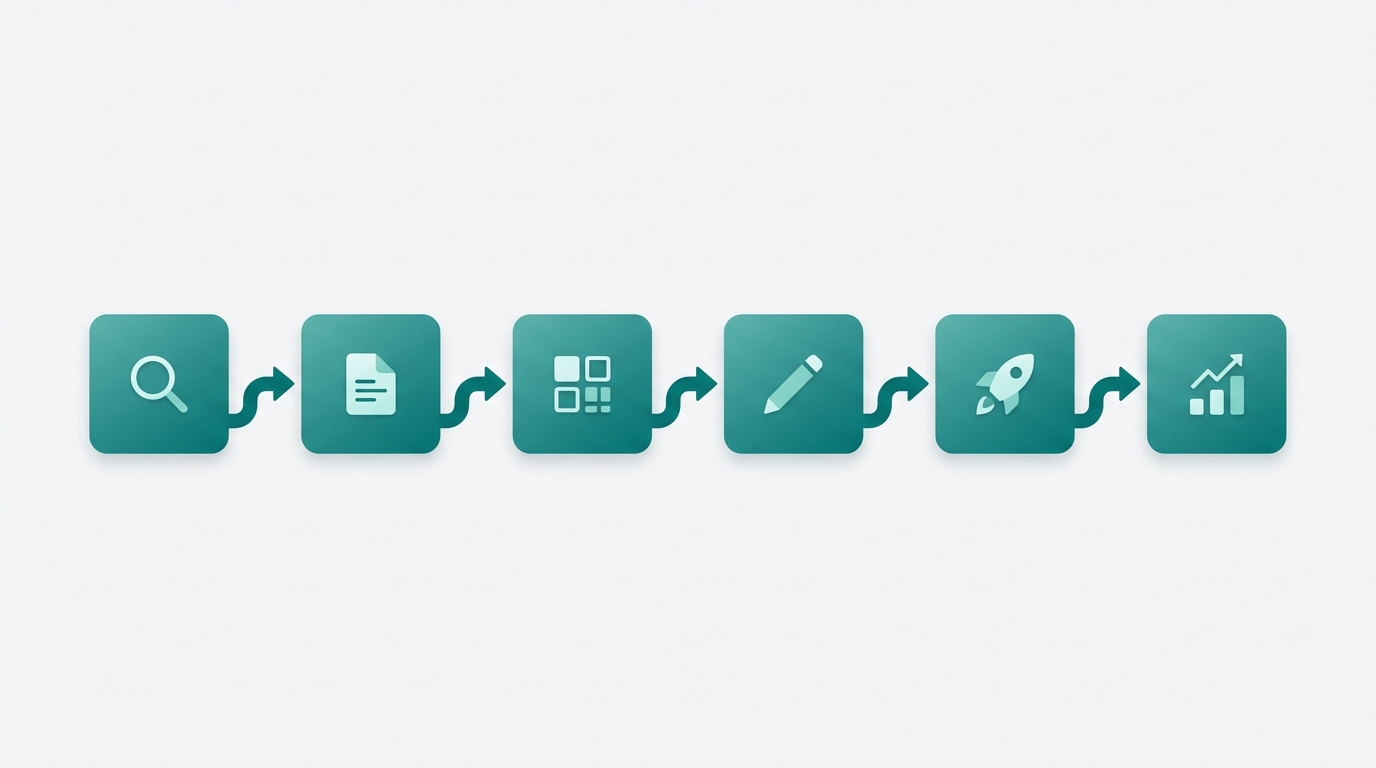
Every stage of the feature lifecycle can produce a content output. Right now, most of those outputs are either missing or disconnected from each other.
Map the stages like this:
- Plan: run a keyword demand check before writing a line of spec
- Research: pull competitor feature pages, map SERP structure, identify AI overview patterns
- Spec: decide page template and URL structure before dev starts
- Draft: write the landing page, launch post, and changelog entry in parallel
- Launch: all three assets go live on the same day as the feature
- Measure: track rankings, signups from the feature page, and activation rate for users who landed there
productledseo.com makes the point directly: SEO without a hypothesis is a to-do list. Each stage should produce a testable output, not just a task that got checked off.
Timing matters more than most founders expect. A feature page published the day the feature ships captures early-adopter search volume before competitors can react. Demand and semantic analysis should be the first step, not an afterthought, which means the keyword research happens before the spec is written, not the week after launch.
The solo founder constraint is real here. This system has to run without a content team. That means each stage needs tooling that does the research and writing, not just a template to fill in manually at 11pm.
Step 1: Research the Keyword Before You Write the Spec
The most common mistake: treating keyword research as a post-launch task. By the time the feature ships, the URL is already set, the headlines are already written, and retrofitting SEO into the page means rewriting copy that's already in production.
Run competitor feature pages through a research query before the spec is written. The goal, as ideadigital.agency describes in their Step 1 approach, is to map queries to specific use-case pages, not just broad category terms. "AI writing tool" is a category. "AI writing tool with live citations" is a use case. The use case page wins on conversion and competes on a narrower, more winnable SERP.
For every feature, identify three query types:
- The problem query: "how to X" (captures people who don't know a solution exists)
- The comparison query: "tool A vs tool B for X" (captures people actively evaluating)
- The capability query: "software that does X" (captures buyers with clear intent)
Aligning feature pages with how buyers actually search for capabilities is the difference between a page that ranks for your brand name and a page that ranks for a problem your buyer is googling at 9am.
Use an AI writing agent to pull competing pages, extract the heading structure, and surface the questions those pages answer. That output becomes your brief. A tool like Ryterr does this in the research step before a single word of the draft is written, so you're not starting from a blank doc, you're starting from a map of what already exists and where the gap is.
The output of this step is a one-page keyword brief: target query, secondary queries, competing URLs, and the angle that differentiates your feature page from what already ranks.
Step 2: Build the Page Template Before Dev Ships

URL structure is a decision, not a default. Make it before the feature ships, not after.
/features/citation-checking ranks. /blog/announcing-citation-checking-v2 does not, at least not for the queries that matter. URL and template decisions made before content is written are one of the highest-leverage choices in a product-led SEO system because they're nearly impossible to fix cleanly after a feature has been indexed.
Design the template around the three query types from Step 1:
- Hero section: answers the problem query, one sentence, keyword included naturally
- Capability section: answers the capability query, three to five bullets with concrete evidence
- Comparison section: answers the comparison query, brief, factual, no hype
Feature pages convert well because they match the buyer's mental model at each stage of research. The template enforces that match every time, even when the person drafting the page is the same person who also wrote the spec and fixed three bugs that morning.
Structure for AI overviews matters too. Use a short definition paragraph, a numbered or bulleted capability list, and at least one concrete example. As of May 2026, structured pages appear more likely to be cited in AI search experiences. A page that answers a specific capability question cleanly has a real shot at appearing in an overview, which puts you in front of buyers before they've even clicked a result.
The template is a reusable asset. Every future feature launch fills the same structure. Over time, your /features/ directory becomes a compounding SEO surface, not a graveyard of one-off launch posts.
Step 3: Write Three Assets on Launch Day, Not One
One launch, three assets. This is the part most founders skip because it sounds like more work. It isn't, if the brief is already done and you have a tool writing from it.
The three assets:
- Feature landing page: evergreen, keyword-targeted, lives at
/features/[name] - Launch blog post: narrative, shareable, links to the landing page
- Changelog entry: short, structured, links to both
An AI writing agent like Ryterr drafts all three from the same keyword brief: the landing page copy, the launch post with inline citations, and the changelog note. One brief in, three assets out. The research step already pulled the competing pages and the SERP structure, so the drafts aren't generic, they're written against a specific gap.
Fact-checking isn't optional. If the launch post says "reduces time-to-X by 40%," that number needs a source or it needs to come out. Content published under your name with a fabricated stat is a trust liability, especially when buyers are actively researching your product. Ryterr's live fact-checking step addresses this directly: "Real citations. No fabricated URLs." The same scrutiny that applies to research posts applies to feature launch content.
The internal linking structure matters. Follow this chain every time:
- Changelog entry links to the launch post
- Launch post links to the feature landing page
- Feature landing page links to the signup or activation flow
This structure passes link equity down the chain, keeps readers moving toward conversion, and gives search engines a clear signal about which page is the canonical destination for that feature.
Step 4: Measure What Actually Matters (Not Just Traffic)
Traffic is a lagging indicator. Organic sessions tell you a page exists in the index. They don't tell you whether the page is doing anything useful.
The metrics that matter for a feature page:
- Signups from the feature page (direct attribution)
- Activation rate for users who landed on the feature page vs. users who signed up directly
- Ranking position for each of the three query types from Step 1
productledseo.com frames this precisely: rank means nothing if it doesn't connect to activation. A feature page ranking third for a high-intent capability query but producing zero signups has a conversion problem, not an SEO problem. A feature page with strong conversion but no rankings has a brief problem.
Set a 90-day hypothesis for each feature page at launch: "If this page ranks in the top five for [capability query], we expect X signups per month with Y% activating the feature." Write it down. Review it at 30 days, 60 days, and 90 days.
Iterate on the page, not just the post. Tracking commercial intent metrics rather than just organic sessions is what separates a content system from a content archive. If the landing page ranks but signups are low, rewrite the conversion copy. If rankings are low, go back to the brief.
Schedule a 30-day review for every feature page. Add a FAQ section targeting long-tail queries that surfaced in Search Console after launch. Those queries are buyers telling you what they're actually searching for. Answering them on the page is faster, cheaper, and more effective than building a new page from scratch.
The SaaS teams with real traction from product-led SEO treat feature pages as living documents, not launch artifacts. The page that shipped in Q1 gets updated in Q2 with new evidence, new FAQs, and better internal links. Compound growth in rankings works the same way it does in products: small improvements made consistently.
FAQ
Do I need to publish the feature landing page before the blog post, or does order matter?
Publish them simultaneously if you can, but if you have to choose, prioritize the landing page. The landing page targets commercial-intent queries and is the asset you want indexed first. The blog post exists to drive links and shares to the landing page, so it's most valuable after the landing page is already live and indexed.
What if my feature is too niche to have meaningful search volume?
Niche features often have niche search volume, but the buyers who do search are highly qualified. A feature page for a narrow capability query with 50 monthly searches can outperform a generic page with 5,000 if the conversion rate is high enough. The product-led SEO framework is built for exactly this case: specific pages for specific use cases, not broad content for broad audiences.
How do I handle features that are still in beta or have rough edges?
Publish the page anyway, but be precise about what the feature does today. Don't make claims you can't back up with a source or a real example. A page that accurately describes a beta feature ranks better and converts better than no page at all. You can update the copy as the feature matures. The URL stays the same, which means the page accrues authority over time rather than starting over.
Can I use one AI-generated draft for all three assets, or does each one need its own brief?
One brief, three drafts, each with a different angle. The landing page is scannable and keyword-dense. The launch post is narrative and shareable. The changelog entry is three to five sentences, structured, and includes links to both. If your AI writing agent treats all three as the same format, the output will be flat. Give the tool the format context for each asset separately, even if the keyword brief is shared.
How long before a feature page starts ranking?
Most feature pages see meaningful movement in 60 to 90 days, assuming the page is indexed quickly and the internal linking is set up correctly. The pages that rank fastest are usually the ones with the clearest structure: a specific capability query in the title, a short definition paragraph, a concrete capability list, and at least one real example. Ahrefs' SaaS SEO data consistently shows that pages matching specific commercial queries outpace generic content pages on ranking timelines, not just on conversion.
Sources
- Victoria Olsina: Product-Led SEO
- Idea Digital Agency: Product-Led SEO Framework
- Product Led SEO: SEO Without a Hypothesis
- Product Led SEO: Google I/O 2026
- productledseo.com
- Ahrefs: SaaS SEO Guide
Before your next feature ships, run the brief. Ryterr does the research, drafts all three assets, and fact-checks every claim before the copy touches your blog. The first post takes about five minutes to set up. Start here.
Ryterr Team
Written with Ryterr: researched on the live web, written in our voice and fact-checked before publishing.