


Search Intent Mapping: Turning Keywords Into Post Briefs
You exported 200 keywords from Ahrefs last Tuesday. They're sitting in a spreadsheet, sorted by volume, color-coded by difficulty. You've done the work. Now what?
Most founders stop here and start picking keywords that "feel right." They write the post. They publish. Three months later, page three. The keyword was fine. The intent match wasn't.
A keyword list is not a content plan. It's raw material. Turning it into a plan means assigning intent, grouping by topic, reverse-engineering the SERP, and building a brief before a single sentence of copy gets written. This post walks through that chain, step by step, with no gaps.
Why Your Keyword List Is Not a Content Plan
Pull up any keyword export. You've got a column for search volume, one for keyword difficulty, maybe one for current ranking position. What you don't have: any signal about what format Google wants to serve for each of those queries.
That's the gap. Moz, Ahrefs, and Semrush all explain the four intent types clearly. What they don't give you is a repeatable workflow from raw keyword export to structured brief. You get the theory, not the process.
Skipping the intent step can be one of the reasons well-written posts don't rank. You can write a 2,000-word how-to guide on a keyword where the top five results are all comparison roundups. Google has already decided what format serves that query. Your format disagreement costs you the ranking, not your writing quality.
The fix isn't more content. It's better pre-work. The rest of this post covers the full chain: export to classification to clustering to brief, with AI handling the classification labor and you staying editor-in-chief.
The Four Intent Types, With One Practical Rule Each
Keep these definitions short. You don't need a textbook.
Informational: the searcher wants to learn something. Think "how to write a meta description" or "what is keyword difficulty."
Commercial: the searcher is comparing options before a decision. Think "best SEO tools" or "Ahrefs vs Semrush."
Transactional: the searcher is ready to act. Think "buy Ahrefs plan" or "Semrush free trial."
Navigational: the searcher wants a specific site or page. Think "Ahrefs login" or "Semrush pricing page."
One SERP signal for each type:
- Informational: featured snippets and "People also ask" boxes dominate the top of the results page
- Commercial: comparison tables, review roundups, and "X best tools" lists fill the top five
- Transactional: product pages and "Start free trial" CTAs appear above the fold
- Navigational: the target brand's own pages take up most of page one
Here's the practical rule that ties all four together: if the top three results are a different format than what you planned to write, your format is wrong, not your keyword. Don't fight the SERP. Read it.
Ahrefs notes that re-optimizing existing pages for intent mismatch is one of the highest-ROI moves in SEO, precisely because it fixes ranking failures without requiring new content to be created from scratch.
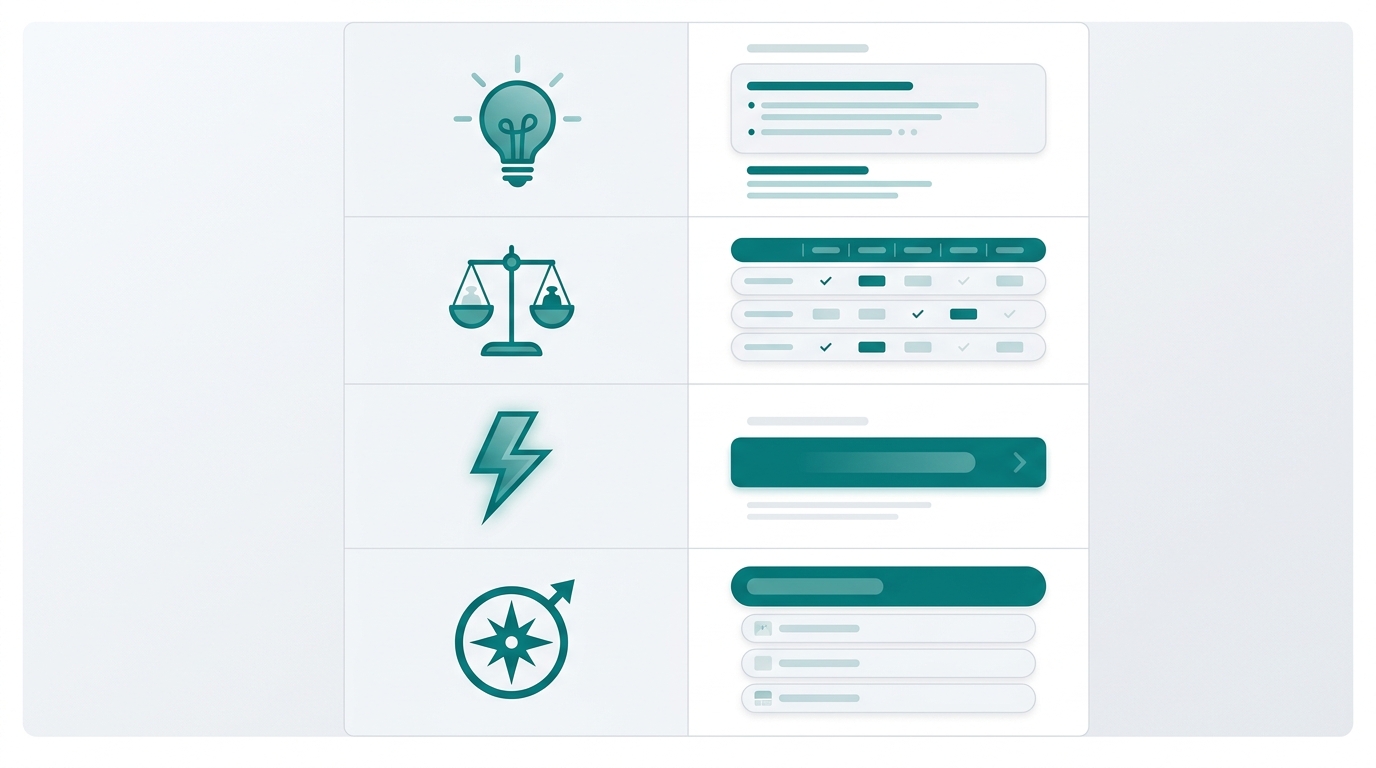
Step 1: Export, Clean, and Classify Your Keyword List
Start with a clean pull. From Ahrefs, Semrush, or Google Search Console, export with these columns at minimum: keyword, monthly search volume, keyword difficulty, and current ranking position if you have one. Everything else is noise for now.
Before you classify, clean. Remove navigational queries — brand names, site-specific searches, anything where the searcher is looking for a specific destination rather than content. Remove pure transactional queries ("pricing," "buy," "download") unless you have a dedicated product or landing page to match them. Trying to rank a blog post against transactional SERPs is almost always a losing trade.
Now classify what's left. Use a four-column tag system: I, C, T, N. Apply it in two passes:
- First pass by modifier pattern: "how to," "what is," "guide," "tips" = informational. "Best," "top," "vs," "review," "alternatives," "comparison" = commercial. "Pricing," "free trial," "coupon," "buy" = transactional.
- Second pass: spot-check any ambiguous term with a real SERP. Fifteen seconds. Look at what format dominates the top three results. Tag accordingly.
This is where AI earns its keep. An agent can batch-classify 50 to 100 keywords in one pass using modifier patterns and SERP signals, cutting what would otherwise be a couple of hours of spreadsheet work to just a few minutes. Surfer SEO and others have written about intent classification at scale, but the tooling for doing it across an entire keyword set, not just a single URL, is still underdeveloped in most platforms.
Step 2: Cluster by Intent and Topic, Then Prioritize
You've got a classified list. Now group it. Intent first, topic second.
Group all informational keywords together before you break them into topics. Do the same for commercial. Don't mix intent types inside a cluster just because the keywords share a parent topic. A "how to set up Google Search Console" post and a "best Google Search Console alternatives" post both live under the GSC umbrella, but they serve completely different reader states and need completely different formats.
Once you've got intent-grouped clusters, apply a prioritization filter. For solo founders publishing one to four posts per week, rank each cluster by three criteria:
- Search volume across the cluster (not just the head term)
- Keyword difficulty relative to your domain's current authority
- Whether you have a real point of view, original data, or a specific story to add
That third criterion matters more than most SEO guides admit. Content Harmony points out that intent match is necessary but not sufficient for ranking in competitive SERPs. You also need a differentiated angle. If you don't have one, deprioritize the cluster until you do.
One more thing to check: cannibalization. Two keywords in the same informational cluster with overlapping SERPs should become one post targeting both, not two posts competing against each other. One strong post beats two weak ones every time.
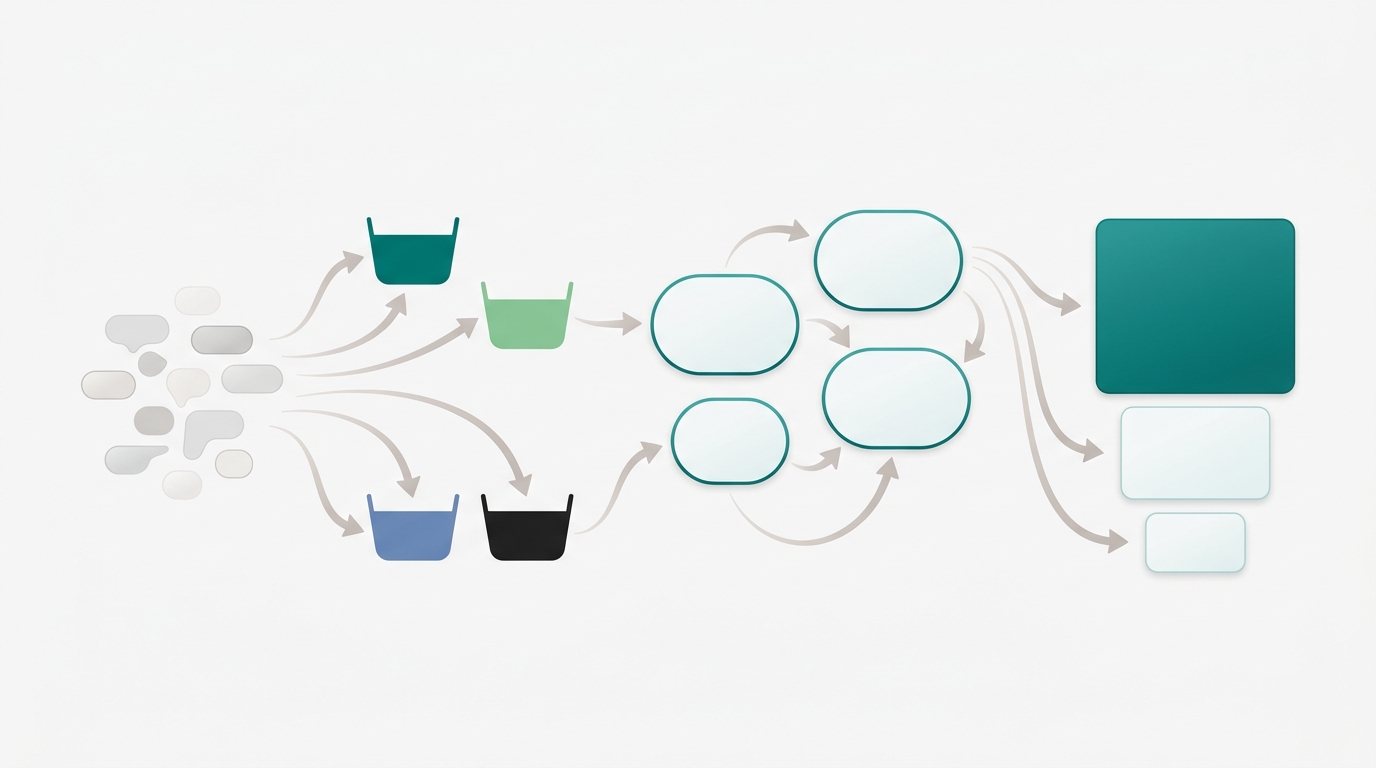
Step 3: Reverse-Engineer the SERP Before Writing a Word
For each keyword you've prioritized, open the SERP and pull five data points from the top five results:
- Content format: listicle, how-to, comparison, opinion piece, tool/calculator
- Approximate word count: long-form or short? Is there a clear pattern?
- H2 structure: what subtopics do all the top results cover? That's your floor.
- Media presence: do results include tables, tools, video embeds, or calculators?
- Domain authority of ranking pages: are these big publications or smaller sites with good content?
The first four tell you what you must include. The fifth tells you whether the door is open.
Now do the angle gap check. What do the top results not cover? A missing data point. A more recent example. A founder-specific perspective that a content farm can't replicate. That gap becomes your differentiation hook in the brief. Ahrefs calls this inferring intent from SERP patterns. The goal isn't to clone the top result's structure. It's to understand the floor and find what you can add above it.
Be honest about the time math here. Doing this manually for ten keywords can take three to four hours. An AI agent that pulls and summarizes top results can cut this to under ten minutes per keyword. At four posts per week, that time difference compounds fast.
Step 4: Generate the Brief With an AI Agent (and Stay Editor-in-Chief)
A complete brief has eight components. Every one of them matters.
- Target keyword and secondary keywords
- Intent classification
- Recommended format and word count range (based on SERP analysis from Step 3)
- Required H2s, drawn from the subtopic patterns you found in the top results
- Specific stats or studies to cite, with source links
- Internal link targets within your existing content
- A one-sentence angle statement: what makes this post different from what's already ranking
- A brand voice note: a short reminder of tone, style, and what the post should not sound like
The transparency requirement is non-negotiable. A brief generated by an AI agent should show its work. Which sources did it pull? Which competing pages did it analyze? Which claims did it flag as needing verification? If you can't audit the brief, you can't trust the draft that follows from it.
Brand voice is where many AI writing tools can fall flat. A brief that's just a structure template produces generic output. A brief that includes a specific voice note — "write like a founder explaining this to a peer, not a content marketer explaining it to a buyer" — produces copy that actually sounds like you.
Ryterr runs this exact sequence: research, SERP analysis, brief generation, fact-checking, and quality scoring, with every step visible in the pipeline. The founder sees what sources were pulled and what competing pages were analyzed before a word of the draft gets written. No black box.
An AI agent that generates the brief and the draft from a single keyword input removes that dependency without removing your editorial control. You're not out of the loop. You're earlier in it.
FAQ
What if a keyword could fit two different intent types?
That happens more than you'd expect, especially with commercial and informational overlap. When a keyword is genuinely ambiguous, check the SERP. If the top results are split between comparison posts and how-to guides, you have two choices: target the format that makes up the majority of top results, or write a post that satisfies both intents by covering the "what it is" and the "which one is best" in the same piece. The SERP is the tiebreaker, not your preference.
How many keywords should I cluster before starting to write?
Classify and cluster your full export before you write anything. Even if you're only going to publish one post this week, knowing how all your keywords relate to each other prevents you from writing posts that will cannibalize each other later. The clustering work done once upfront saves you from rewriting posts six months from now.
Do I need a high-authority domain before this workflow is worth doing?
No. In fact, the prioritization step in clustering is specifically designed for lower-authority domains. When you filter by keyword difficulty relative to your current domain strength, you're building a queue that's winnable at your current size. You're not waiting until you have a DR 70 domain. You're finding the open doors at DR 30 and walking through them.
How do I handle keywords where the top results are all from huge publications?
Two options. One: skip the cluster for now and come back when your domain has more authority. Two: look harder for the angle gap. Big publications cover topics broadly. They rarely cover them from a specific founder's perspective, with real numbers from a real product. A niche, specific, data-backed post from a smaller domain can outrank a generic overview from a large one if the intent match and differentiation are strong enough.
Can I skip the SERP check if I already know the topic well?
You can, but you'll regret it occasionally. The SERP is the ground truth for what Google has already decided to serve for a query. Even if you're an expert on the topic, you might assume the right format is a how-to guide when the top results are all comparison posts. That assumption costs you the ranking. The SERP check takes 15 seconds per keyword. It's worth doing every time.
Sources
- Moz: Search Intent
- Ahrefs: Search Intent
- Semrush: Search Intent
- Surfer SEO: Search Intent
- Content Harmony: Search Intent
Take the next keyword on your list. Open a SERP tab. Tag the intent. Note what format the top three results use. Write a one-paragraph brief with a required H2 list before you touch the draft. If you want steps 1 through 4 handled by an AI agent, connect your domain on Ryterr, paste your keyword, and let the pipeline run. Review the brief it generates. Edit anything that doesn't sound like you. Then ship.